
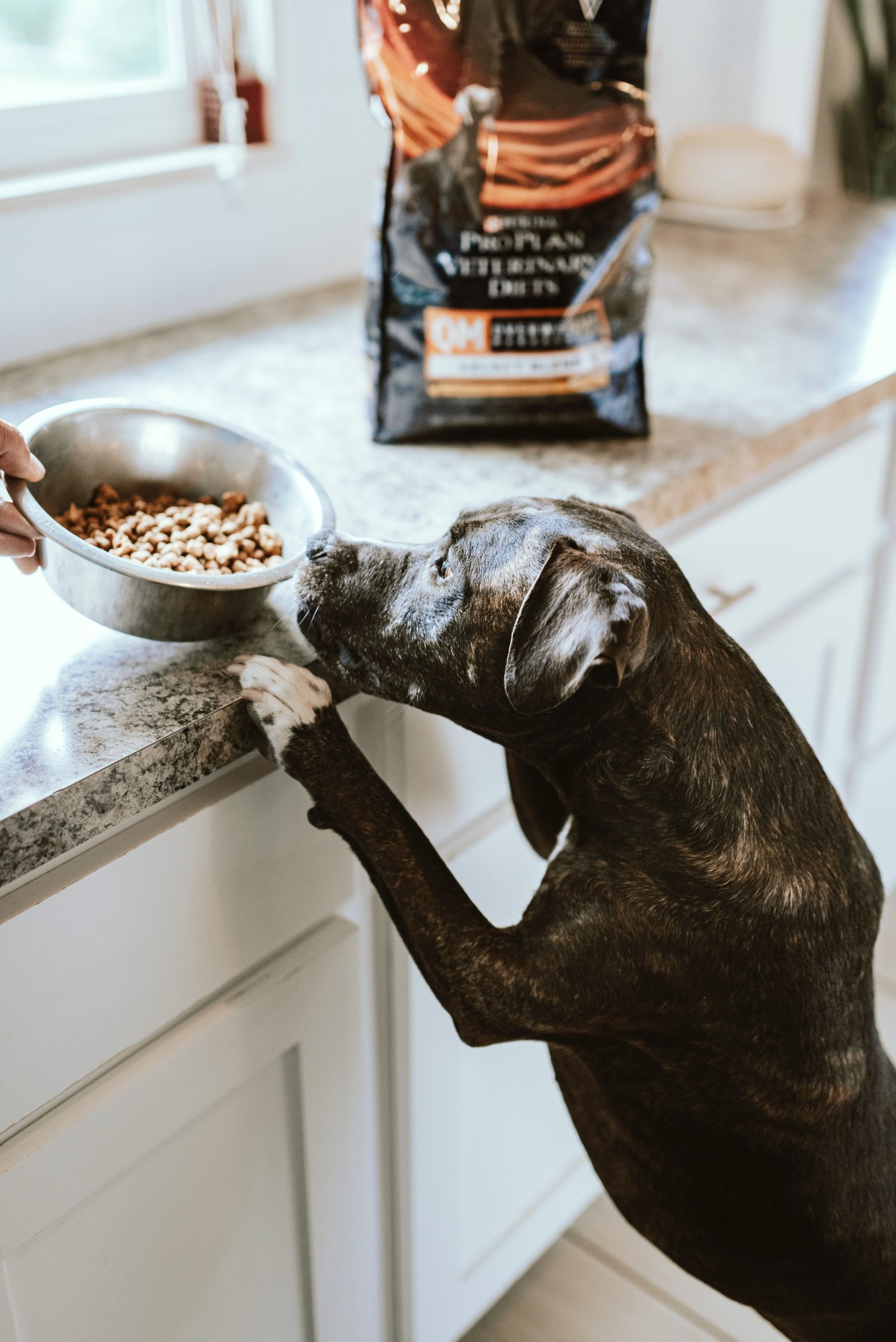

We all want what is best for 0ur fur babies, ranging from love and care to nutrition.
I am sure anyone who has shopped for dog food knows that there are virtually hundreds of options and brands of food with loads of ingredients: wet, dry and raw food, age-specific food, maintenance diets, restricted diets, to name but a few. So many choices and then included in all of this is all sorts of advertising and marketing claims to unravel.
The label on the package is the best tool to use when you make a choice, but if anyone who has looked at a label knows they are not easy to understand – never mind needing a degree to decipher the information, fantastic eyesight is imperative– a magnifying glass is a prerequisite, (maybe just for us older folks).
I am going to try simplifying and explain how to read a dog food label.
Most pet food labels must have the following eight required label items for pet food. According to AAFCO, the following must appear on packaging:
Product and brand name.
- Name of species for which the pet food is intended.
- Quantity statement – how much food is in the bag.
- Guaranteed analysis – this specifies the amount of specific nutrients.
- Ingredient statement – this must be listed in descending order by weight.
- Nutritional adequacy statement, which must be backed up by testing that proves the food provides a certain level of nutrients. It can also include the life stages the food is appropriate for.
- Feeding direction/instructions.
- Manufacturers or distributors name and address.
Ok, this is the list but now, what does that mean? I will give a short description to demystify the wording on some of them – the rest are self-explanatory.

Product and brand name:
95% Rule: At least 9 5% of the product must be the named ingredient like “Beef for Dogs,” it must include at least 95% beef, not counting the water for processing. When counting the water, the main product must be about 70% of the total product. The remaining 5% will be those required for the nutritional reasons like vitamins and minerals and small amount of any other ingredient.
25% Rule: “Snookims Chicken Dinner,” “Beef platter for puppies,” are examples of 25% rule. The named ingredients must consist of at least 10% of the total product by weight and at least 25% of the product by weight (not including the added water). The product must, however, include the qualifying terms, like “dinner,” “platter” and so on.
“With” Rule: Including words “with” or “similar” to a label, e.g., “Delish stew with real Beef,” the “WITH …” ingredient needs only to be 3% of the product. So, the product must have at least 3% beef. While “Teds Super food with Lamb and Rice,” should contain at least 3% Lamb and 3% rice.
Flavour Rule: If the label says , “Lamb Flavour Dog Food,” then a specific % of lamb is not required but must provide the flavour and the flavour descriptor must be printed in the same size, style and colour as the word “lamb.”
Guaranteed analysis:
There are four basic nutritional guarantees required.
- Minimum percentage of crude protein
- Minimum percentage of crude fat
- Maximum percentage of crude fibre
- Maximum percentage of moisture
Crude refers to the specific method of testing the product, not the quality of the products.
Ingredients:
This section I think is the most important part to read. Ingredients must be listed in descending order by weight, individually, and any collective ingredients such as ‘animal protein product’ are not allowed. If the meat or meat by-products do not come from cattle, swine, sheep or goats, the species must be declared in the ingredient list.
Nutritional Adequacy Statement:
Look for the fine print on the inside or back of the package – this is another important part of a label as it is the key to matching pets’ nutritional needs with a product.
“Complete and Balanced” means that the food has met specific standards and provides complete and balance nutrition for all stages of adult dogs, as stated by AAFCO. “Complete” means the product contains all the nutrients and “Balanced” means that the nutrients are present in the correct ratio.
Life Stages – the recognized life stage is:
- Gestation/lactation
- Growth
- Maintenance
- All life stages

Different quantities and ratios of nutrients are necessary for different life stages.
Feeding Directions:
Remember these are guidelines, not regulations. The label tells you how much you should feed, but remember breed, temperament, environment, and various other factors can influence food intake.
It is important to take note of ‘sell by’ or ‘best-used-before” and do not buy or use before, as expired dog food does offer less nutritional value and can grow harmful bacteria/mold that can make your dog sick.
So, to break it down, here is the shortened version to help you remember all the above when you are standing in the food aisle.
- The first ingredient listed is the greatest ingredient in the food by weight.
- The sell-by date stops you from buying food that is rancid or gone bad.
- The guaranteed analysis tells you how much protein, fat, fiber and water the food contains.
- The quantity of different products should be compared on a cost per kg.
- Feeding directions are recommendation, not rules. Do your body conditioning score, as provided in last newsletter.
Hope this will assist you when shopping and trying to read the label.
0 Comments